
AI-Based Attribution Models Explained: 5 Questions Every Executive Is Asking in 2026
Dive Into Our Podcast
Q1. What is AI marketing attribution and how does it compare to what we have now?
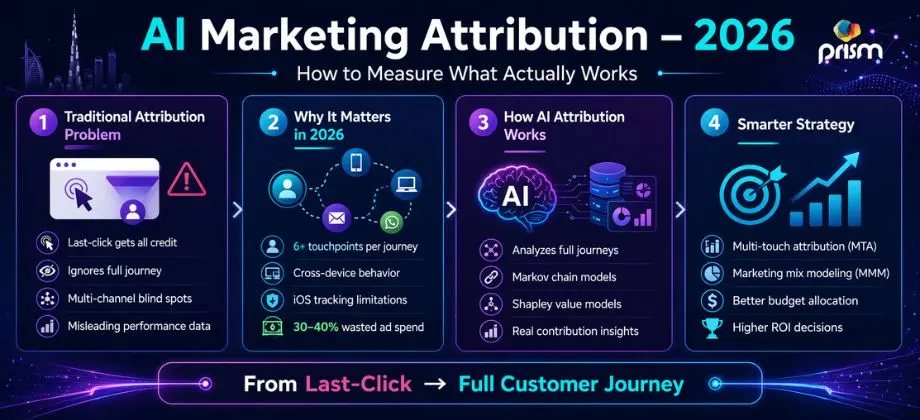
Conventional marketing attribution is based on the following rules: first-touch attribution gives 100% credit to the first touch in the journey, last-touch credit is assigned to the last touch before conversion, and linear attribution divides the credit equally. These are human approximations, not what actual evidence of what drove the sales.
With Attribution based on AI a fitting analogy would be to say that instead of those rules we now have machine learning. Rather than applying a fixed logic, the model studies thousands of customer journeys — both buyers and non-buyers — in order to detect which touchpoint combinations really correlate with sales. It is easier to understand it like a rule-based model is what decides who won a football game by observing who touched the ball last. An AI model watches thousands of games and sees that the assist, the screen, and the defensive stop all contributed.
Q2. Why does this matter now? Hasn't attribution always been imperfect?
Yes — but the gap between what attribution shows and what actually happened has never been wider. Three forces converged in 2025 to break traditional models almost completely. Firstly, the iOS privacy adjustments led many mobiles stages of the journey to be hidden from client side tracking. Secondly, today’s consumers engage in more than six touchpoints with businesses before converting, and these interactions take place across a variety of devices and over the span of days or weeks. Thirdly, in 2026, the vast majority of B2B marketing teams (67%+) are still only looking at last-touch attribution — a model that effectively ignores every interaction except the last. The cost is real: marketers waste an estimated 30–40% of ad spend because their attribution model is pointing to the wrong channels.After a major campaign like Ramadan — where you may be running Meta, Google, email, WhatsApp, and influencer simultaneously — last-touch tells you almost nothing useful about where to invest next time.
Q3. How does AI attribution actually work — without the technical jargon?
There are two approaches you will hear about:
Markov Chain Models: These treat the customer journey as a sequence of steps. The AI computes the probability that each step can be followed by the next one. Then it wonders: What if we take away this entire touchpoint, how much would the conversion probability fall? High drop = high contribution. This is how you learn that your YouTube pre-roll, which looks inactive in last-touch reporting, is actually the reason 40% of your customers ever heard of you.
Shapley Value Models: Borrowed from game theory, this approach asks: across every possible combination of marketing channels, what is the marginal contribution of each one? What value does adding Meta ads bring when combined with Google Search? The answer is a precise credit allocation that reflects genuine influence, not just timing. Both models learn continuously. As new campaign data flows in, the model adapts — you are never locked into assumptions made at the start of the year.
“AI attribution examines every converting journey and every non-converting journey in your data. It identifies which touchpoint combinations correlate with conversions versus drop-offs — processing signals that would be impossible for humans to identify manually.”
Q4. What marketing mix modelling? And why is everyone talking about it?
We see two dominant frameworks rising as a result of Marketing Analytics AI in 2026. Multi-touch attribution (MTA) tracks individual users across channels. Marketing Mix Modelling (MMM) takes a wider view: it uses aggregate campaign data to model how all of your marketing inputs — together — drove outcomes. MMM is emerging as the strategic winner: 46.9% of US marketers plan to increase MMM investment over the next year, and 27.6% named it the most reliable measurement methodology in an EMARKETER/TransUnion survey.Why? Because MMM does not depend on user-level tracking. It works even as privacy restrictions remove cookie data. For markets like the UAE where campaign audiences cross languages, devices, and channels simultaneously, MMM gives executives a cleaner cross-channel view than any single-touch model can. The best-practice approach combines all three: MMM for the strategic cross-channel view, MTA for daily campaign optimisation, and incrementality testing to validate that campaigns actually caused the results — not just correlated with them.
Q5. How do we apply this to analyse our Ramadan campaign performance right now?
Start with the data that you have. Take your campaign touch points from Meta, Google, email, and any other active channels. Look at the full path to conversion for each customer, not just the last click. If your CRM or analytics platform supports multi-touch or data-driven attribution — GA4's data-driven model, for example, uses machine learning to distribute credit — switch to it immediately. Three questions to drive your April review: Which channel introduced the most new customers? Last-touch won't show this. First-touch or Markov chain models will. Which touchpoint sequences converted fastest? AI models can surface patterns like: 'Meta Reel → Google Brand Search → WhatsApp link' converted at 3x the rate of any other path during Ramadan week one. Which spend showed genuine increments? Even without a formal experiment, comparing conversion rates in weeks you ran upper-funnel activity versus weeks you did not gives you directional evidence of true lift.The goal is not a perfect model. It is a significantly better model than last-click — one that tells you where to confidently invest in the next campaign cycle.
What Does This Mean for Executives Making Budget Decisions?
Digital Marketing ROImeasurement is not a reporting exercise. It is a budget decision tool. The top companies in 2026 will be those employing AI-based attribution to understand which combinations of channels, types of creative, and segments of audience yield supernormal returns — and then they’ll be going “all in” on those before the competition does. (Lean Summits, leansummits.com, 2026)
To all UAE businesses reviewing their Ramadan sales this month, the pragmatism is simple: stop treating your last-click metric as the truth, and start constructing a view of the whole customer journey. Some small changes to your attribution model will reveal budget decisions that last-click reporting has obscured.
If you want help building an AI analytics marketing (sk) framework for your specific campaigns and channels, Prism Digital works with businesses across the UAE to implement the right measurement stack for their size and ambition. As a marketing agency in UAEwith direct experience across Ramadan campaigns in real estate, retail, and financial services, we can translate these frameworks into decisions your team can act on today.

About The Author: Lovetto Nazareth
Lovetto Nazareth is a digital marketing consultant and agency owner of Prism Digital. He has been in the advertising and digital marketing business for the last 2 decades and has managed thousands of campaigns and generated millions of dollars of new leads. He is an avid adventure sports enthusiast and a singer-songwriter. Follow him on social media on @Lovetto Nazareth